Obtaining the necessary consent from the LLC’s current members
Revising the applicable legal and internal documents
Notifying the IRS
There are many benefits to adding a member to an LLC. However, there are other changes to be aware of, including a possible change in tax status, which may require your business to be taxed as a partnership or corporation instead of a disregarded entity.
Below is a step-by-step guide to adding a member to an LLC, discussing the advantages and disadvantages of this change and what it could mean for you and your organization.
Let’s go ahead and define “member” – A member of an LLC is the owner, and it can be a natural person, an entity, or a trust.
1. Review your Operating Agreement
The terms of your Operating Agreement explain how to add a new member, including things like who needs to consent to the addition. If your LLC doesn’t have this document, then your state’s default LLC rules about member additions will apply instead.
If you’re unsure about what your Operating Agreement requires or what the state default rules are, you can consult with a LegalShield® provider lawyer who can examine your state’s LLC laws or your Operating Agreement and explain how adding a member to your LLC works.
2. Discuss and determine the terms of admission
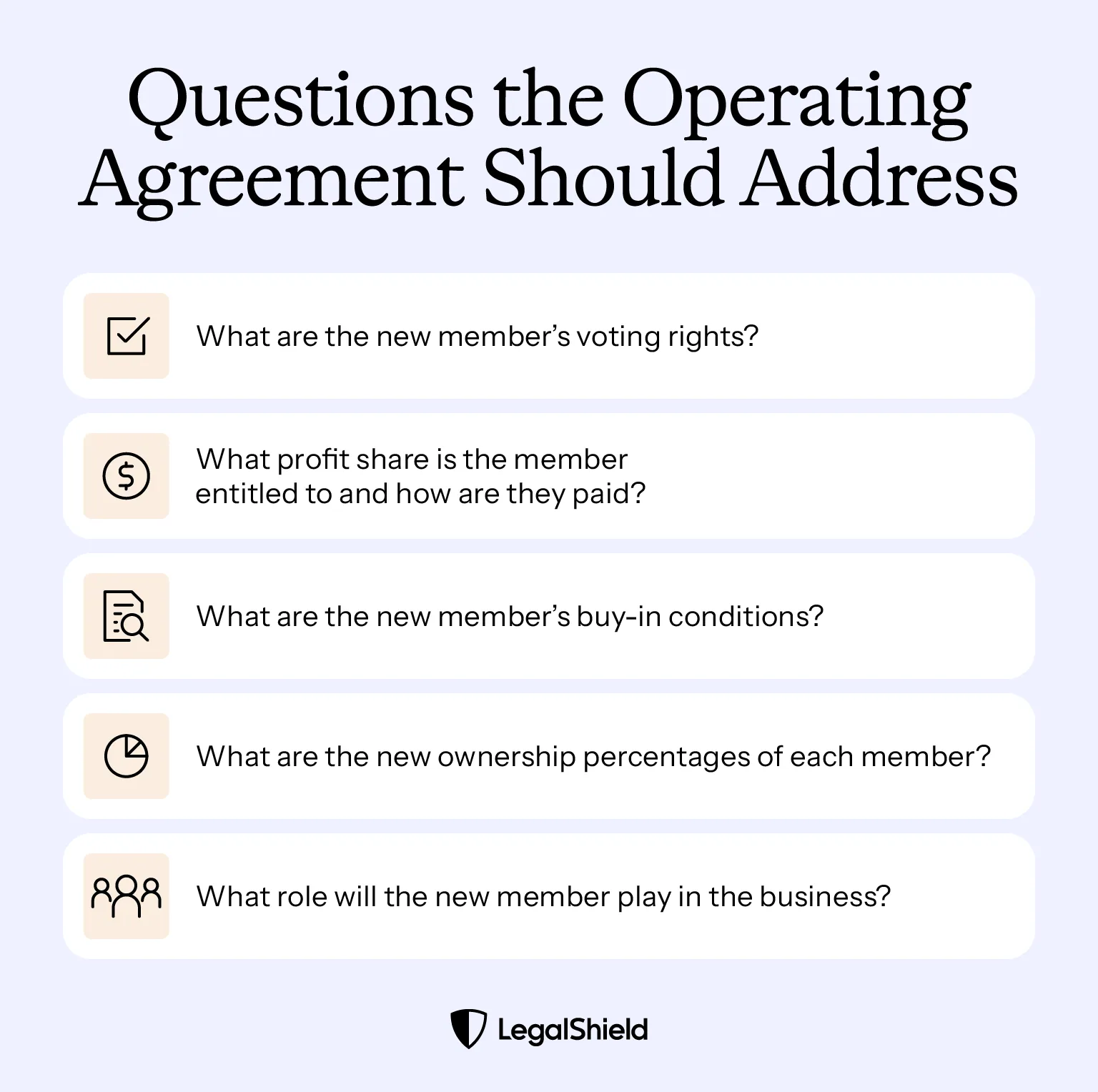
If the Operating Agreement allows the addition of a new member, it’s at this time that you apply the new member requirements. The terms most likely to be applicable are:
Ownership: The existing membership (or the terms of the Operating Agreement) must decide the percentage of the new member’s ownership interest. Keep in mind that the new member’s ownership share won’t always match the amount of money or property the new member contributes to the LLC.
Capital contributions: This explains the type of contribution the new member will provide (cash or certain assets) and the amount or value of that contribution.
Voting rights: The Operating Agreement (or applicable state default rules) will decide what the new member’s voting rights will be, assuming they have any.
Profit and loss allocation: The new member will share in the LLC’s gains and losses, but it needs to be explained whether these rights apply only to profits and losses or also to changes in LLC assets and liabilities.
What happens if a member dies, is incapacitated, or files bankruptcy: Now that you have another owner of your LLC, it is important to discuss what will happen to that member’s ownership in the event something bad happens.
3. Approve the new member
The terms of the Operating Agreement will show how to add a new member. If there’s no Operating Agreement (or the Operating Agreement lacks relevant terms), the state’s default LLC rules will apply.
In most cases, the current members must approve the new member with at least a simple majority. However, there could be other voting requirements.
For example, an Operating Agreement might require every existing member to vote to approve the new member. Or if the new member gets a simple majority vote, it must include a “yes” vote from a particular member. However, the approval process works. It will need to be documented with either a written resolution or in meeting minutes.
4. Amend your legal documents
After the new member has been approved, it’s time to update the LLC’s legal documents. These documents need to be modified to reflect the addition of a new member.
For example, what kind of voting and profit-sharing rights will the new member have? The answer to these questions will need to be provided by amending the Operating Agreement. Besides changing (or creating) the Operating Agreement, your LLC may also need to change other documents, such as the:
Articles of Organization
Membership/ownership certificates
5. Update your records
In addition to updating the LLC’s legal documents, you may also need to update its internal records, such as:
Administrative records: Documents that support LLC operations, such as the membership register and meeting minutes.
Financial records: This can include capital contribution records and authorizations for access to company bank accounts.
State records: In addition to updated Articles of Organization, these include annual or biennial reports and registered agent documents.
6. Address tax and EIN changes
The IRS considers single-member LLCs to be “disregarded entities,” meaning the taxable income from the LLC is reported on the owner’s individual tax return. However, adding a new member means creating a multi-owner LLC.
The IRS doesn’t treat multi-owner LLCs as disregarded entities. Instead, the LLC’s income has to be reported on a partnership or corporate (S or C) tax return. If you haven’t obtained an EIN already, this change in membership necessitates the LLC to obtain an EIN, or Employer Identification Number. If you already have an EIN, you will want to discuss with your CPA the proper forms to file with the IRS to notify them of your change in tax classification. How you choose to classify your multi-member LLC will determine what type of tax return you need to file for your LLC.
7. Revise business records
The LLC must also make the necessary changes to reflect the addition of a new member. This may include revising:
Ownership records: These records should reflect changes in each member's ownership interests. This is important because it may change profit-and-loss distributions. For example, if an LLC has four members, each with a 25% ownership interest, and a fifth member is added, each member might now have a 20% ownership interest. Instead of each member receiving 25% of the profits (and losses), they now receive 20%.
Bank signature cards: To give the new member access to the LLC’s bank account, the new member must be added to the account. This is typically done by updating the bank account signature cards.
Existing contracts: If any existing contracts don’t include new members, they may need to be updated.
Payroll documents: The new owner may receive a salary from the LLC. If that’s the case, the payroll records should be updated to reflect this salary.
Pros and cons of adding a member to an LLC
Forming your business as an LLC comes with its share of advantages and disadvantages. There are also things to consider when adding a new member to the LLC. Before going through with the change, it’s important to carefully weigh the pros and cons.
Pros
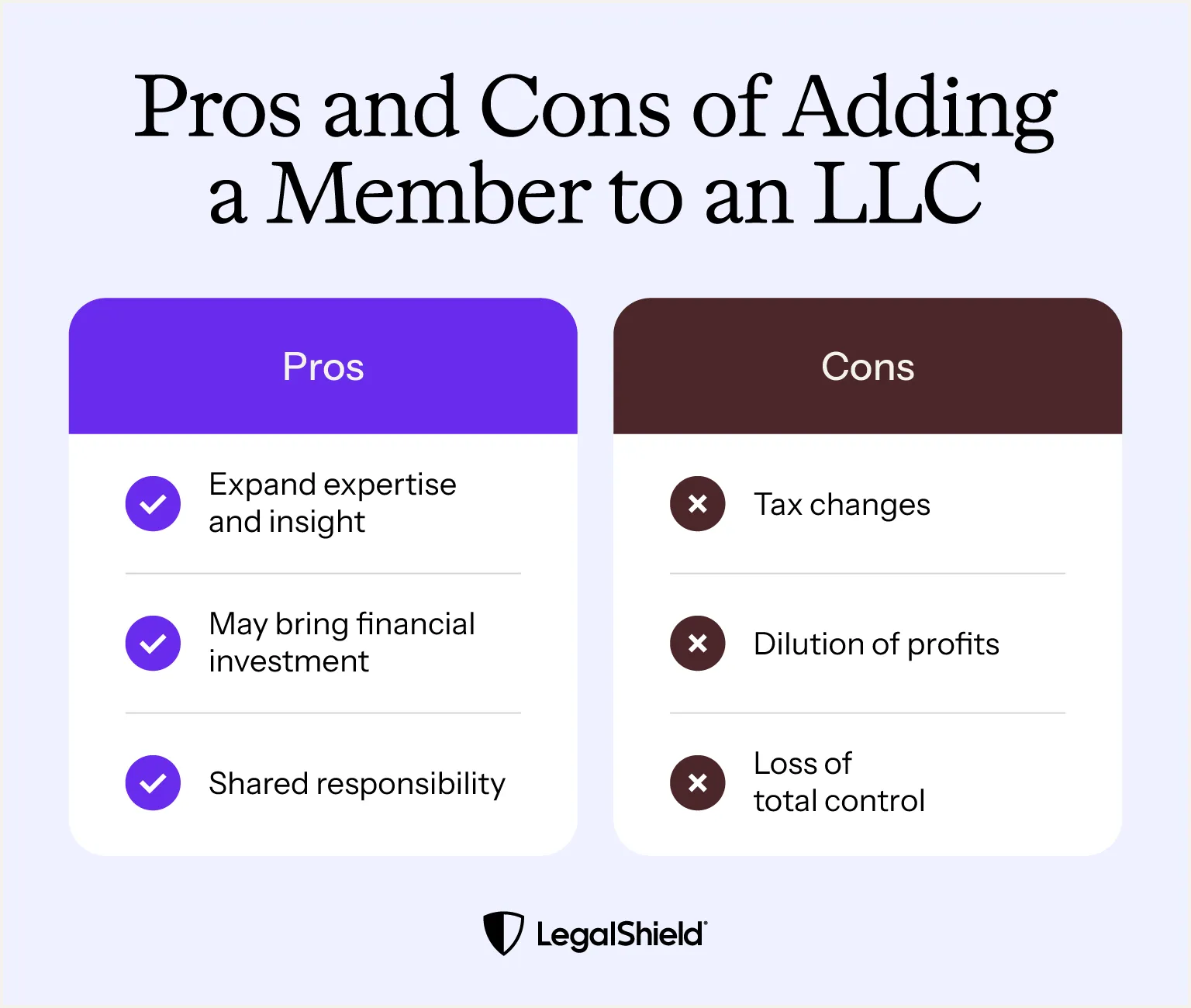
Some notable benefits of adding a new member to an LLC include:
Added expertise and experience: having the skills of a new member can expand the LLC’s client base, as well as allow the LLC to provide additional services or products to potential customers.
Increased capital: Adding a new member is a great way for the LLC to obtain funding, whether it’s to help pay off current debts or expand operations.
Shared responsibility: It can be beneficial to have a partner to share responsibilities with, especially if your LLC is member-managed.
Cons
Adding a new member to an LLC includes a few potential drawbacks, such as:
Tax changes: If shifting from a single to a multi-member LLC, the LLC will no longer be taxed as a disregarded entity. Depending on the LLC’s new tax status and the tax brackets, this could result in paying more taxes to the IRS.
Lower profits: Adding another member usually means existing profits must be divided among the additional members. If the new member’s addition doesn’t lead to a corresponding increase in profits, it could mean less money for each owner.
Diminished control: An additional owner means another voice and opinion in how the LLC should be run and operated. It can also be challenging to remove a member once they’ve been added.
Protect your growing business with LegalShield® Plans
Expanding your LLC offers many benefits, but the process isn’t always simple. It varies depending on where your LLC is based and how it was created. If you’re thinking about changing your business to meet its growth needs, consider a LegalShield Membership.
You’ll be connected with a lawyer who can give you business legal advice to help you protect your business as it grows without the high hourly fees. This includes reviewing contracts and in some situations, helping with commercial litigation.
To learn more about what LegalShield has to offer, check out the different business plans available. The multiple selection options let you choose which LegalShield services fit your budget, so you only pay for what you need.
Frequently asked questions
Can you add members to an LLC?
Yes. Most LLCs are set up to make it easy to add new members. The Operating Agreement will usually explain how this process works.
Does it cost money to add someone to an LLC?
If you have to file updated documents with the state, there will be filing fees to do so, which vary from state-to-state. There may also be additional legal or accounting costs if outside professional help is required to update the Operating Agreement and prepare tax filings.
What are the tax implications of adding a member to an LLC?
It can vary, but the biggest change is when shifting from a single-member to a multi-member LLC. Instead of taxing the LLC's profits as a disregarded entity, the IRS will treat it as a partnership or corporation.
Do I need a new EIN when adding a member to a single-member LLC?
Not necessarily. If you already have an EIN for your LLC, you may just need to file the appropriate forms to designate a new tax classification for your EIN. If you do not have an EIN already for your LLC, you can file for one and choose your tax classification during the application process.
Does adding a member require unanimous member approval?
It depends. Your LLC Operating Agreement sets the rules about adding a new member. If you do not have an Operating Agreement, your state laws may provide the requirements.
What should the amendment to LLC Operating Agreement include?
You’ll need to make the changes necessary to reflect the additional member. This can include changes to voting rights, profit distribution, management responsibilities, and succession plans in the event that one or more current members leave the LLC.
What are the pros and cons of adding a spouse to an LLC?
The benefits of adding your spouse include more advantageous retirement contribution benefits, a more streamlined succession plan, and greater protection from creditors. Drawbacks include shared control, increased paperwork when forming the business and filing taxes, and additional tax liability, as both spouses can be taxed on the LLC’s profits.
Content Specialist at LegalShield, creating educational resources about legal and consumer protection topics. She focuses on making complex legal and financial concepts accessible to readers and has contributed to various educational articles on consumer rights and protections.
Dissolving an LLC can be tricky, and doing it without guidance can lead to unnecessary stress and delays. We’ve put together some helpful information so you can start the LLC dissolution process with more peace of mind.
An employment contract is an important piece of paperwork because it defines the working relationship, your expectations, and conditions. Here are some of the common components included.
Virtual business addresses can be a practical option for those forming an LLC from home, working remotely, or trying to keep their business and personal mail separate.
By the end of this blog, you’ll get a high-level summary of trademarking a name and logo, how logos differ from business names and artwork, and how much it all costs.
A DBA is a name registration that lets you run your business under a name other than your personal legal name or legal business entity. While a DBA offers branding flexibility and market expansion opportunities without creating a new legal structure, it does not provide legal liability protection, tax benefits, or function as a business license.
An indemnity agreement settles the “who is responsible” question ahead of time. One party promises, in writing, to cover certain losses tied to the work, so the other isn't left with the bill. These promises appear in construction contracts, leases, and business sales.
A certificate of good standing is official proof from your state that your business is registered and current on its requirements. Most lenders and agencies want a recent one, so it helps to know how to get it before someone asks.
Whether the goal is selling a company, bringing in a business partner, or passing it to a family member, the LLC ownership transfer often involves reviewing the LLC's operating agreement and the applicable state's rules.
•
11 min read
Thank you! You're subscribed!
Oops! Something went wrong while submitting the form.