A renters’ insurance policy protects your personal belongings and liability while renting an apartment.
Personal property coverage covers the cost to repair or replace your personal belongings.
Personal liability coverage can help protect you from financial losses due to at-fault accidents in the home.
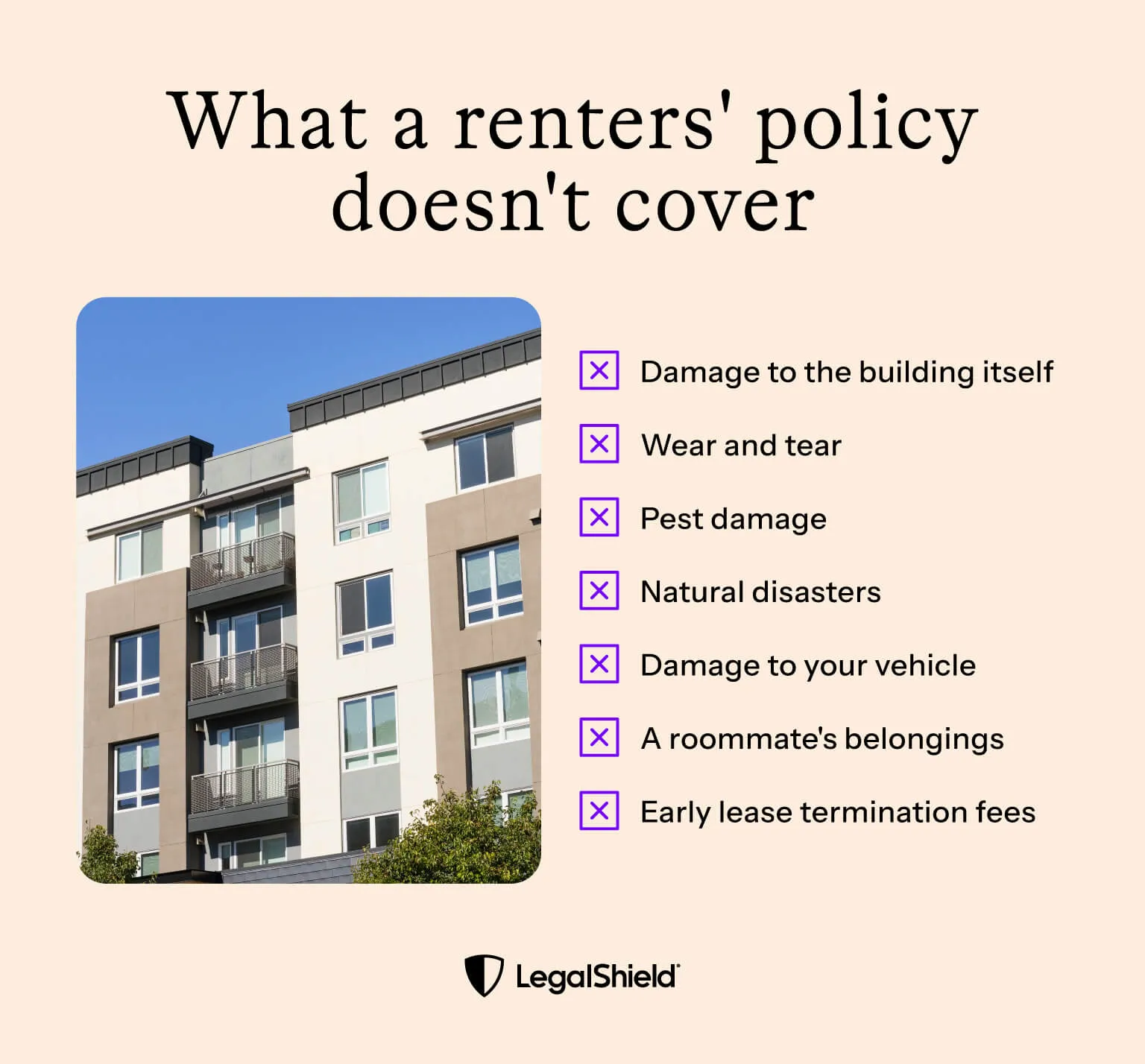
Renters’ insurance policies do not cover damage to the building itself, wear and tear on personal belongings, or damage from pests (such as rodents or insects).
Editor's note: This post was originally published June 13, 2023 and has been updated for accuracy, comprehensiveness and freshness on August 12, 2026.
Signing a lease usually comes with a stack of paperwork, and somewhere in it is often a line requiring renters’ insurance. Insurance can feel dense and a little intimidating the first time you deal with it, and renters’ policies come with their own set of coverages, limits, and exceptions that companies don’t always spell out plainly.
Navigating renters insurance doesn't have to be complicated. Here's a clear look at what it actually covers (and what it doesn't), the four main types of protection, and the right questions to ask before picking a policy.
And if the lease behind that insurance requirement is the part giving you pause, a LegalShield® Personal Plan connects you with provider lawyers who can review it and walk you through your rights as a renter.
What is a renters' insurance policy?
Renters’ insurance is a type of policy that helps pay to repair or replace your personal belongings if there is a covered loss and can help protect you if you’re found responsible for someone else’s injury or property damage, whether it happens at your rental or elsewhere. You can get it while you rent an apartment, house, condo, or live somewhere without a formal lease.
A renters’ policy doesn’t typically cover the building itself. That part is the landlord’s responsibility, and they typically have a separate rental property policy to cover it. However, a renters’ policy can step in if you’re found responsible for damage to the place you rent. This is one reason landlords might set a minimum liability amount as a condition of the lease.
What does a renters’ policy cover?
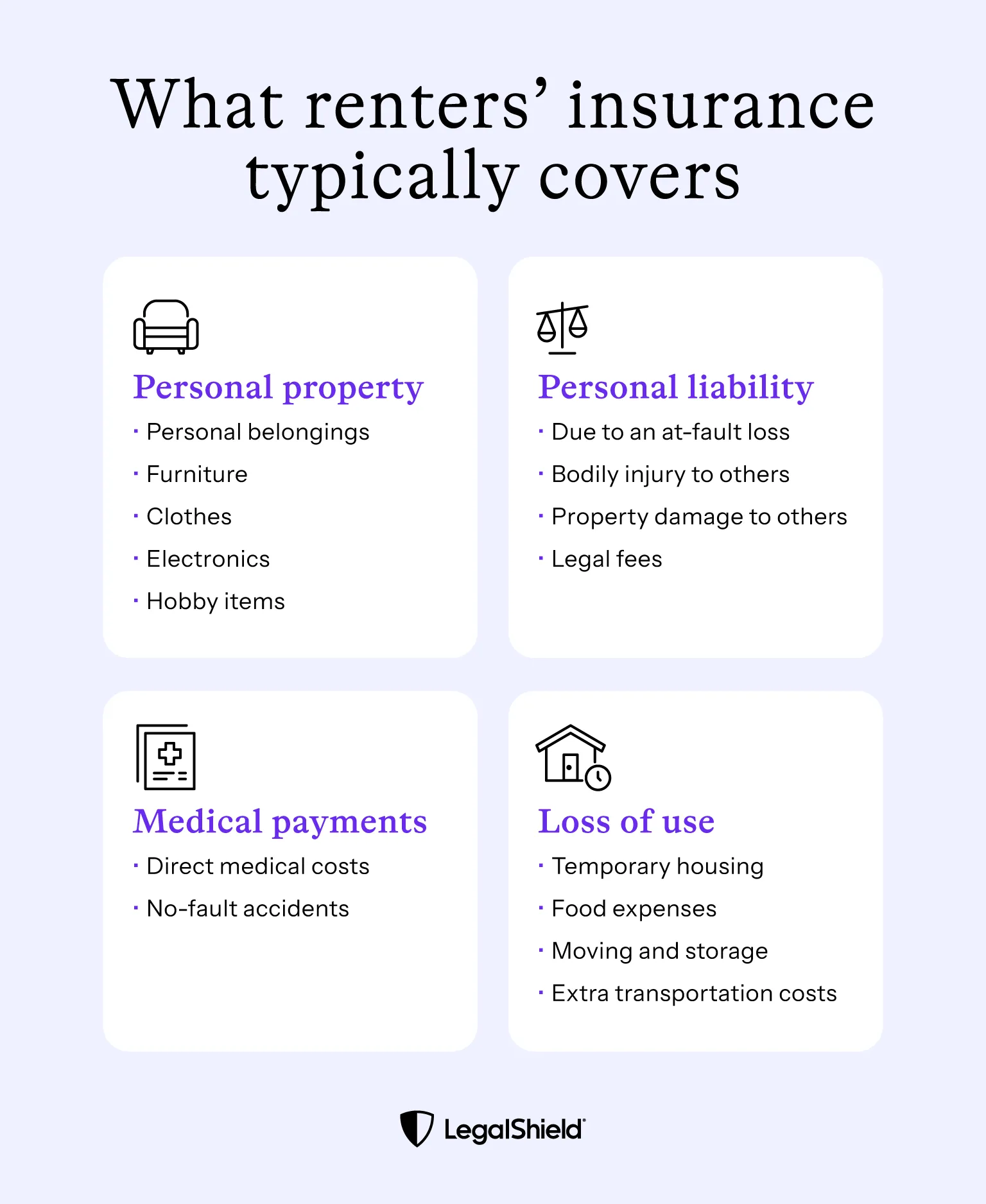
Renters’ insurance policies work by covering your personal property, personal liability, medical payments to others, and loss of use. Your insurance policy’s declaration pages call them Coverage C, E, F, and D, respectively.
Personal property (Coverage C)
Personal property coverage (coverage C on your “declarations page”) helps pay for the cost to repair or replace your belongings when they are damaged or lost due to covered events. What counts as a covered event may vary depending on your policy, but typically includes losses like fires, theft, smoke, lightning, and accidental water damage (such as from a burst pipe).
Personal belongings can include items like:
Furniture
Clothing
Electronics
Kitchenware
Decorations
Policyholders often pay a deductible before their personal belongings coverage kicks in. Using your coverage requires you to pay your deductible if you have one. You would’ve set this number up when creating the policy.
If you have high-value items, such as jewelry, fine arts, and firearms, your renters’ insurance policy may set special limits on these. You should consider seeking additional coverage through a value property policy in these cases.
Check with your insurance provider to learn more about coverage limits and deductible requirements.
Actual cash value vs. replacement cost coverage: Actual cash value (ACV) coverage pays to replace or repair home goods, taking into account their wear and tear. Replacement cost value (RCV) coverage compensates for the cost of replacing with materials of like kind and quality.
Personal liability (Coverage E)
Personal liability helps protect you from financial losses if you are found legally responsible for someone else’s bodily injury or property damage. This coverage applies both inside and outside the home, but typically doesn’t apply if you’re found liable for injuries and damage due to an automobile accident.
Liability coverage varies by insurance provider, so it’s important to talk with yours to understand what’s included.
Medical payments to others (Coverage F)
Medical payments coverage compensates visitors for minor medical expenses if they sustain an injury in your home. Insurers consider this “no-fault” coverage, meaning it pays out regardless of who caused the injury. If the costs exceed what this coverage amount states, the rest may fall to your liability coverage (if you were at fault).
Loss of use (Coverage D)
Loss of use coverage helps pay the extra costs of temporary housing and living expenses while your home is under repair if a covered event makes it unlivable. Some renters' policies call this “additional living expenses” (ALE), meaning it covers the extra costs associated with these items:
Temporary lodging: A hotel or short-term rental while you wait for repairs to finish.
Food: If your temporary place doesn't have a kitchen, ALE can help cover the added cost of eating out.
Extra commuting costs: If your temporary place is farther from work than your usual commute, your policy may cover the difference.
Storage: A monthly storage unit for belongings that don't fit in your temporary place.
What doesn’t a renters’ policy cover?
Renters’ policies cover many losses, but they aren't bulletproof. Here's a breakdown of what they typically don't cover:
Damage to the building itself: Walls, roof, and plumbing are the landlord's responsibility, covered by their insurance.
Wear and tear: Gradual damage to the building or your belongings over time.
Pest damage: Damage from insects or rodents, which is treated as preventable maintenance.
Natural disasters: Events like floods and earthquakes, which usually require separate coverage.
Damage to your vehicle: Renters’ insurance policies usually don’t apply to damage to your vehicle.
A roommate's belongings: Unless the roommate is listed on your policy as an additional insured.
Get a LegalShield® Membership to connect with a provider lawyer to review your lease documentation
Renters' insurance and lease agreements sometimes feel very complicated. Having a law firm in your corner to explain them takes a lot of the stress of understanding them off your plate.
With a LegalShield Personal Plan, you can talk to provider lawyers who can review your lease, explain your rights as a renter, and talk through your options when a landlord isn't holding up their end.
Sometimes. It all depends on what caused the water damage in the first place. If a pipe bursts or a sink leaks and something valuable gets hurt by the water, your policy may cover the costs incurred. But if a natural disaster floods your basement, you might be out of luck.
If your personal property is stolen out of your home, your policy should pay the cost of that property. Just make sure you have paid enough to cover the worth of your belongings.Your renters insurance policy will not cover vehicle theft. However, if a thief breaks your car window and steals items out of your vehicle, your policy will not pay for the car damages—but it may pay the costs of those stolen items.
Landlords want to protect you, themselves, and everybody else. By making sure you have a renters insurance policy in place, landlords can rest easy knowing that you are financially and legally safe if something bad happens. It also adds a layer of protection for them, in case a lawsuit arises.
Renters’ insurance often starts at just a few dollars per month, but can vary heavily depending on the amount of coverage you pay for, the insurance provider you choose, and the state you reside in.
Renters’ insurance may be worth it if you don’t have the cash on hand to easily replace all your personal belongings or cover yourself in case an opposing party tries to make a claim against your personal liability coverage.
Because a renters' policy is designed to protect you and your belongings, the physical building itself is usually covered by the landlord's separate property insurance.
Renters’ insurance can cover theft if someone breaks into your car or mugs you. However, insurance providers may also decline your claim if they find that you were negligent in trying to protect your goods.
Communications Director at LegalShield overseeing content creation designed to make legal protection simple and approachable. He focuses on offering straightforward, trustworthy guidance that empowers people to make informed decisions about their legal rights and responsibilities.
We’ll provide more information about the trustors vs. trustees comparison, what to consider when filling these roles, and how they work together in Revocable and Irrevocable Trusts.
A power of attorney with springing powers is a legal document that grants someone else the authority to act on your behalf only after a specific event occurs.
There’s no rule that says a lawyer has to set up your Trust for it to be valid. However, Trusts are complex and doing it yourself without a lawyer's help comes with risks.
A Certificate of Trust proves your Trust is real and names who can act for it, while your beneficiaries and assets stay private. It lets your Trustee handle Trust business, like opening accounts or transferring property.
A limited power of attorney often comes in handy when you need help for a short time or for a single purpose. This legal document can help in situations like when you’re traveling, serving in the military, caring for an aging parent, or sending a child to study abroad.
We’ll cover some of the most common scams, the red flags that give them away, how to protect yourself, and what to do if you’ve already been caught out.
An executor is responsible for ensuring your final wishes get carried out, so it’s important that you choose someone who is responsible and can bear the emotional burden.
An employer identification number is a nine-digit number the IRS uses to identify a taxpayer. The estate needs its own, and getting one is usually simpler than it sounds. Learn more about estate EINs.
•
5 min read
Thank you! You're subscribed!
Oops! Something went wrong while submitting the form.







.jpg)