Creating a subsidiary LLC is a relatively straightforward process that involves:
Choosing a name for the subsidiary company.
Preparing and filing the articles of organization.
Assigning the parent LLC as the owner of the sub-company.
Creating an operating agreement.
Your business is growing and you’re thinking about an expansion. Should you create another business? Create a new division of your existing one? How about creating a subsidiary LLC?
This last option offers several benefits, such as liability protection, greater tax flexibility, and increased privacy.
Once you decide to create a subsidiary LLC, the next question becomes what that process entails. The answer depends on whether you already have an LLC and in which state you want to create the subsidiary company. That said, the overall process is similar to creating a regular limited liability company, with a few small differences, which we discuss below.
How subsidiary LLCs work
A subsidiary is a company that is owned and controlled by another company. The company that owns the subsidiary is called the parent company. If a company has 100% of its stock owned by another entity, it’s known as a wholly owned subsidiary.
As for what it means to be an LLC, it’s a type of limited liability company that offers several benefits for its owners:
Personal liability protection.
Increased tax planning flexibility.
Greater management control.
Less cumbersome administrative requirements compared to other business structures, like corporations.
Step 1: Consult with professional advisors
Before you dive into the paperwork, the most critical first step is to consult with an attorney and a CPA. While creating a subsidiary is a common way to expand, it isn't the right fit for every situation.
Certain tax classifications or specific business structures may not allow for subsidiaries, or they could trigger unexpected tax implications that outweigh the benefits. A professional can help you determine if this move aligns with your long-term goals.
If you have questions about whether this structure is right for you, LegalShield can help. Our Business Plans provide access to provider lawyers who can offer guidance on your specific business structure and help you decide if a subsidiary is the right path forward.
Step 2: Decide on the structure and naming
Once you’ve cleared the legal and tax hurdles with your advisors, you can pick a name for the subsidiary company. This assumes that you already have a limited liability company that will be the parent LLC. You’ll also need to make sure the parent LLC’s ownership has approved the creation of the subsidiary.
When choosing a name, you’ll need to follow state requirements, which typically include:
The name cannot be already registered in your state.
The name cannot be the same as the parent LLC.
The new name must have wording that indicates it’s an LLC.
If you’ve chosen a name but aren't sure if it’s available, you can search for it on the Secretary of State website.
Step 3: Begin articles of incorporation
What you need to do to complete your articles of organization will depend on your state’s filing requirements. That said, you should expect to include the following information about your subsidiary:
Name
Business purpose
Primary address
Registered agent
How long the LLC plans to exist
Structure of the subsidiary’s management
Step 4: Designate your existing LLC as an owner
This is the first major step beyond creating an individually owned LLC. Because LLCs are allowed to own other LLCs, you will list the parent company as a member/owner of the subsidiary.
You can also list other individuals or companies as members of the subsidiary. If you do this, the parent LLC must have a majority ownership interest in the subsidiary.
Step 5: Create an operating agreement
Of all the documents required to create an LLC, an operating agreement isn’t one of them. It’s still a good idea to do so as it can explain the relationship between the parent LLC and the subsidiary.
An operating agreement is also helpful in explaining how the subsidiary should be managed and operated. It can also outline who’s responsible for any debts of the LLC or entitled to any of its profits. LegalShield’s provider lawyers can answer any questions you might have about operating agreements.
Benefits of subsidiary LLCs
Several advantages come with creating a subsidiary LLC, including:
Separate liability: The parent and subsidiary LLCs are different legal entities. Therefore, the legal liabilities of one LLC don’t apply to the other LLC.
Greater privacy: For some states, if you want to make an LLC’s ownership difficult to discover, you’ll want to list its owner as another LLC.
Regional separation: Creating a subsidiary in another state can help if you want to take advantage of a different state’s business laws (or market share).
Service or business type separation: Each subsidiary LLC can be its own business line. Despite this separation, you can still keep control over the individual business lines.
Branding: Creating a new LLC offers the chance to establish a new brand that’s also legally distinct from the parent company.
Asset protection: A creditor having access to one LLC’s assets doesn’t mean that the creditor automatically has access to the other LLC’s assets.
Ownership and investment: The subsidiary LLC can receive funding and investment capital from the parent LLC.
Management flexibility: You can choose between member and owner-managed management structures. There’s also the option of creating a partially or wholly owned subsidiary LLC.
Tax benefits: Depending on the subsidiary-parent LLC relationship, there may be tax advantages. These can encompass the IRS treating the subsidiary as a disregarded entity or the LLC choosing to be taxed as an S or C corporation.
Challenges of subsidiary LLCs
Several potential trade-offs come with creating a subsidiary LLC:
Complexity: Adding an LLC means more paperwork. This includes more tax filings, operating agreements, accounting statements, and/or member meetings. If the LLCs are in different states, there will be two sets of laws to follow.
Increased costs: Each LLC incurs its own filing, renewal, bank account, and registered agent fees. There may also be state-specific costs, such as taxes, fees, or licensing requirements.
Administration: Both LLCs must take steps to keep their operations separate from each other. This requires keeping separate records, having separate bank accounts, and not using money from one LLC to pay the bills of another LLC.
LLCs as holding companies
A holding company LLC exists to own and control one or more subsidiaries. There are several benefits that come with creating a holding company:
The holding company enjoys liability protection from actions by its subsidiaries, as long as the entities are operated separately and according to law.
The holding company can save money while having majority control over another company. It’s a lot cheaper to buy a 51% stake in a company as opposed to a 100% stake, for instance.
It’s sometimes easier for a holding company to secure business loans to help fund their subsidiaries than for each subsidiary to do so.
The owners of the LLC can profit from many different businesses in unrelated industries. Each subsidiary can have business-specific management to handle the day-to-day decisions.
Subsidiary alternatives
Subsidiary LLCs aren’t always the best choice for growing a business. Depending on business needs, other alternatives might make more sense. This might apply if a business needs a presence in many different states, for example. In addition to a subsidiary LLC, other options are series LLCs, DBAs, joint ventures, and creating a new division.
Because every business is unique, you may want to speak with a professional to weigh these options. A LegalShield provider lawyer can help you navigate these alternatives to find the structure that best supports your expansion goals.
Series LLC
A series LLC involves a single LLC, and instead of subsidiaries, there are “divisions.” Each division has its own finances, assets, and liabilities. States that allow for series LLCs have their own rules about how series LLCs must operate.
A series LLC can offer asset and liability protection without the hassle (and expense) of creating individual subsidiaries. This might be worth considering if your business wants to create a subsidiary LLC in as many states as possible. Not all states have a series LLC available, and those that do have different laws and requirements.
DBA
DBA stands for “doing business as” and allows businesses to operate with a registered name that’s different from their legal name. DBAs make it easy for a single legal entity to establish different brands for different activities. Yet the business can maintain a single legal entity for the business.
DBAs and LLCs have several differences. Basically, a DBA is just an exclusive “nickname” for a business that the business registers with the county and/or state. You might consider a DBA instead of an LLC if your primary goal is to simply create a different brand for your business.
Joint venture
Imagine you want to expand your business into a new area, but you’re afraid your business lacks the resources for this type of growth. A great option in this case might be a joint venture.
A joint venture is an arrangement between two or more businesses in which they work together to achieve a common goal. This relationship usually involves combining the money and expertise of the businesses, while also allowing them to share in the risks and profits.
A joint venture might be a better option than a subsidiary if a business needs outside financial and/or know-how to expand. But this comes with the cost of not having the liability protection of a subsidiary. A joint venture also requires sharing control and profits with another business.
Creating a new division
Creating a new division means you simply “carve out” a separate area of the business for a particular task or goal. The business can create this division any way it wants. It can be as informal as taping a piece of paper to a door, or as formal as building a new office with separate management and staff.
The biggest benefit of creating a division is that it is done internally. There’s also the advantage of existing management having direct control over the division. The biggest risk is that the existing business is fully responsible for any financial or legal liabilities of the new division.
If you’re trying to add a department or business section where full control over this new area is important (and you’re trying to keep costs down), creating a new division might be something to consider.
Tips for keeping LLCs separated
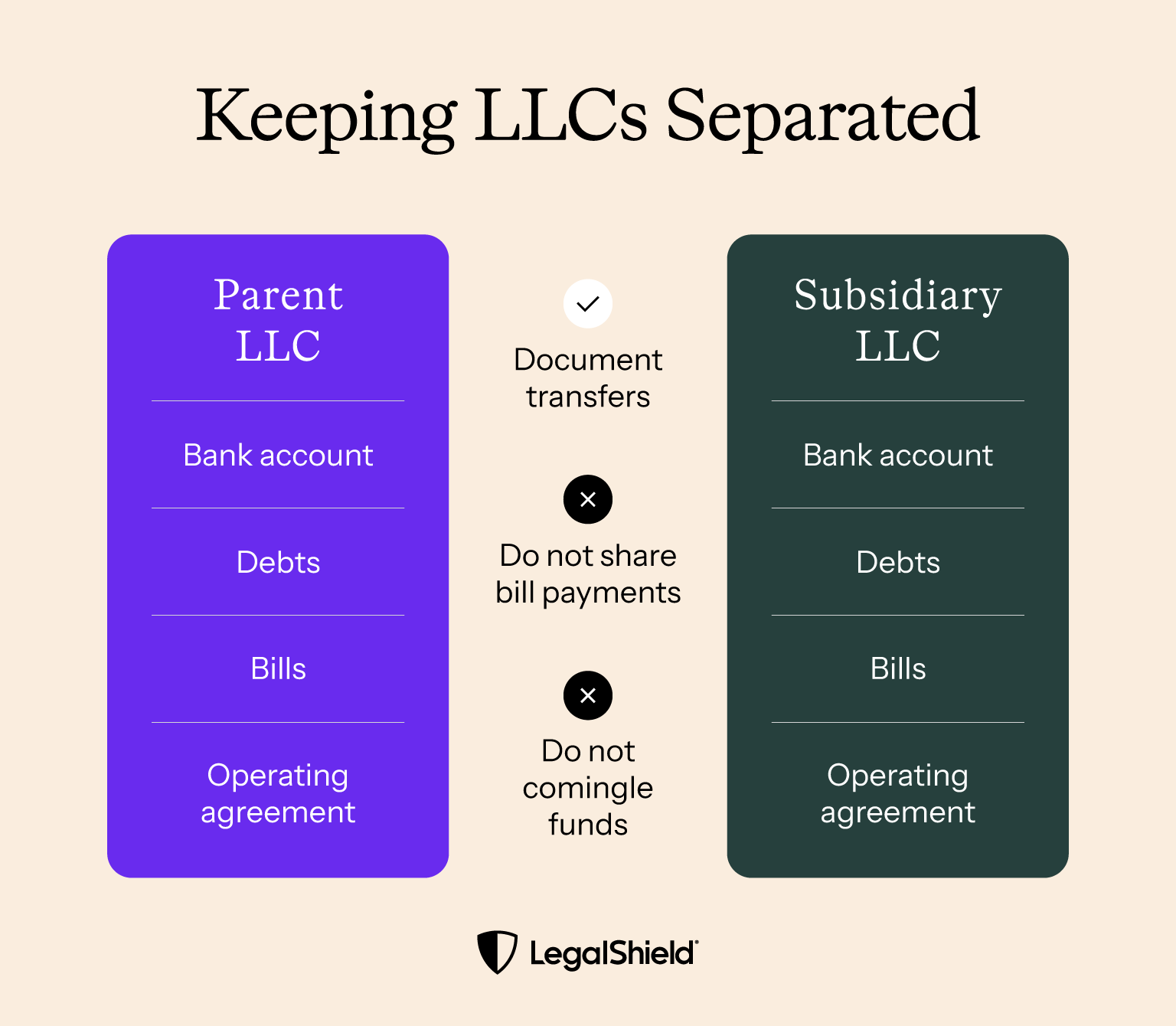
A primary reason for creating a subsidiary is for liability protection. But to keep this benefit, the parent and subsidiary LLCs must operate as separate legal entities. This means:
Having separate bank accounts for each LLC.
Not commingling the finances of each LLC. This includes using money from one LLC to pay the bills of another LLC.
Not creating and maintaining the necessary business records for each LLC.
When transferring funds between LLCs, do so for legitimate business reasons and adequately document the transfer and any loans.
Having separate operating agreements for each LLC.
Get help managing LLCs with LegalShield® Business Plans
Once you’ve decided to create a subsidiary LLC, you might need help with running other parts of your business. LegalShield provides members with support for essential tasks like contract reviews, navigating employment issues, and ensuring your operating agreements meet all state-specific legal standards.
Whatever your business’s legal needs, LegalShield can provide guidance. You can choose from several Business Plans to get advice on the legal issues that matter most to you.
Pre-Paid Legal Services, Inc. (“LegalShield”) provides access to legal services offered by a network of provider law firms to LegalShield members through membership-based participation. Neither LegalShield nor its officers, employees or sales associates directly or indirectly provide legal services, representation, or advice. Small Business Legal Plans and certain benefits are not available in all states. See a Small Business Legal Plan contract for a specific state for complete terms, coverage, amounts, and conditions. The information made available in this blog is meant to provide general information and is not intended to provide legal advice, render an opinion, or provide a recommendation as to a specific matter. The blog post is not a substitute for competent legal counsel from a licensed professional lawyer in the state or province where your legal issues exist, and you should seek legal counsel for your specific legal matter. Information contained in the blog may be provided by authors who could be a third-party paid contributor. All information by authors is accepted in good faith, however, LegalShield makes no representation or warranty of any kind, express or implied, regarding the accuracy, adequacy, validity, reliability, availability, or completeness of such information.
Communications Director at LegalShield overseeing content creation designed to make legal protection simple and approachable. He focuses on offering straightforward, trustworthy guidance that empowers people to make informed decisions about their legal rights and responsibilities.
Copyright is an intellectual property right that gives the creator of a work the exclusive legal rights to it. These rights let creators sell and license the work they create, and it’s an important area of law for small business owners to understand.
Dissolving an LLC can be tricky, and doing it without guidance can lead to unnecessary stress and delays. We’ve put together some helpful information so you can start the LLC dissolution process with more peace of mind.
An employment contract is an important piece of paperwork because it defines the working relationship, your expectations, and conditions. Here are some of the common components included.
Virtual business addresses can be a practical option for those forming an LLC from home, working remotely, or trying to keep their business and personal mail separate.
By the end of this blog, you’ll get a high-level summary of trademarking a name and logo, how logos differ from business names and artwork, and how much it all costs.
A DBA is a name registration that lets you run your business under a name other than your personal legal name or legal business entity. While a DBA offers branding flexibility and market expansion opportunities without creating a new legal structure, it does not provide legal liability protection, tax benefits, or function as a business license.
An indemnity agreement settles the “who is responsible” question ahead of time. One party promises, in writing, to cover certain losses tied to the work, so the other isn't left with the bill. These promises appear in construction contracts, leases, and business sales.
A certificate of good standing is official proof from your state that your business is registered and current on its requirements. Most lenders and agencies want a recent one, so it helps to know how to get it before someone asks.
•
4 min read
Thank you! You're subscribed!
Oops! Something went wrong while submitting the form.