

Small Business
12 min read
How to Trademark a Logo for Your Business
By the end of this blog, you’ll get a high-level summary of trademarking a name and logo, how logos differ from business names and artwork, and how much it all costs.



A virtual business address for an LLC is a real mailing address your business can use without renting or owning office space there. Some business owners use virtual addresses to present a more professional location, get business mail, and keep their home address private.
You don’t necessarily need a traditional office lease if you want a professional business location. That’s thanks to virtual business addresses. These can be a practical option for those forming an LLC from home, working remotely, or trying to keep their business and personal mail separate.
This is a decision that comes with legal and administrative details to think through, though. A LegalShield® Provider Law Firm can help you understand how a virtual address might affect your LLC filings, contracts, and privacy goals.
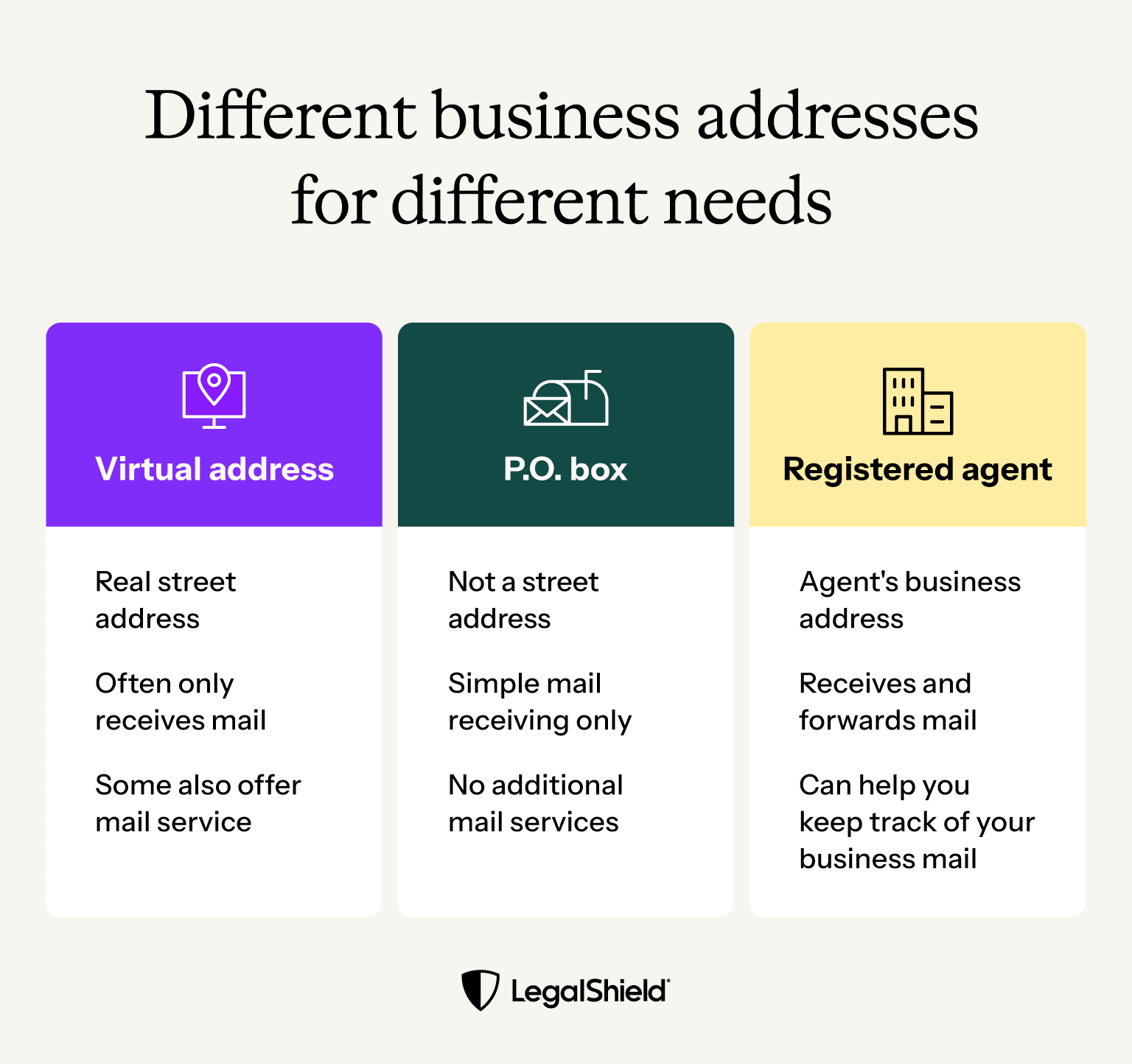
Using a P.O. box or the address of your registered agent might seem like a simple solution, but virtual addresses often let you perform more administrative tasks for your LLC.
Like a P.O. box, a virtual LLC address lets you receive business mail without using your home address. But some banks, government forms, and vendors require a physical street address, not a P.O. box.
Meanwhile, the registered agent address is a different thing entirely. Your LLC registered agent receives official legal notices and documents from the state on your business’s behalf. Some registered agent services do provide an address, but that doesn’t mean you can use it as your general business mailing address.
Virtual office addresses for LLCs can offer a cleaner separation between the owner’s personal life and their LLC. And that’s why many business owners pursue them. If you run your company from home, a virtual address means you don’t have to make your home the default destination for customer mail, vendor mail, or certain public records.
It’s about more than privacy and separation, though. Virtual addresses better fit the way many modern businesses operate. Business owners may work remotely, travel often, or serve customers in more than one market. A virtual business address can help them manage the mail and present their business more consistently.
Here’s what typically attracts some business owners to virtual addresses:
Generally, it’s possible to use a virtual business address to register an LLC. That’s as long as the address is a real street address and the address provider allows you to use it for business filings.
A virtual address doesn’t automatically replace every address you’ll need for LLC registration, though. Your LLC may still need a registered agent with an address that meets state requirements for receiving official legal notices.
So, before you file, it can be helpful to confirm which address goes where on your formation documents and make sure your virtual address provider supports LLC registration.
There’s no shortage of virtual mailing address providers, but the provider needs to be set up to actually receive business mail. Many virtual mailbox services operate as commercial mail receiving agencies (CMRAs). That means they can receive USPS mail for you, but they might need identity verification and USPS Form 1583 before they do so.
Some providers only receive and hold mail. Others will scan and forward it or offer package handling, local pickup, and online mail management.
Address location can matter, too, if you want an address in the same state where you formed your LLC, near certain customers, or in a market where you want your company to have a stronger presence.
Don’t forget the contract details: monthly fees, cancellation rules, mail storage limits, forwarding costs, privacy policies, and what happens if you close the account. A lawyer can review those kinds of contract terms to help you understand what you’re getting.

The specifics vary by state and situation, but the basic outline of how to get a virtual business address usually follows these steps:
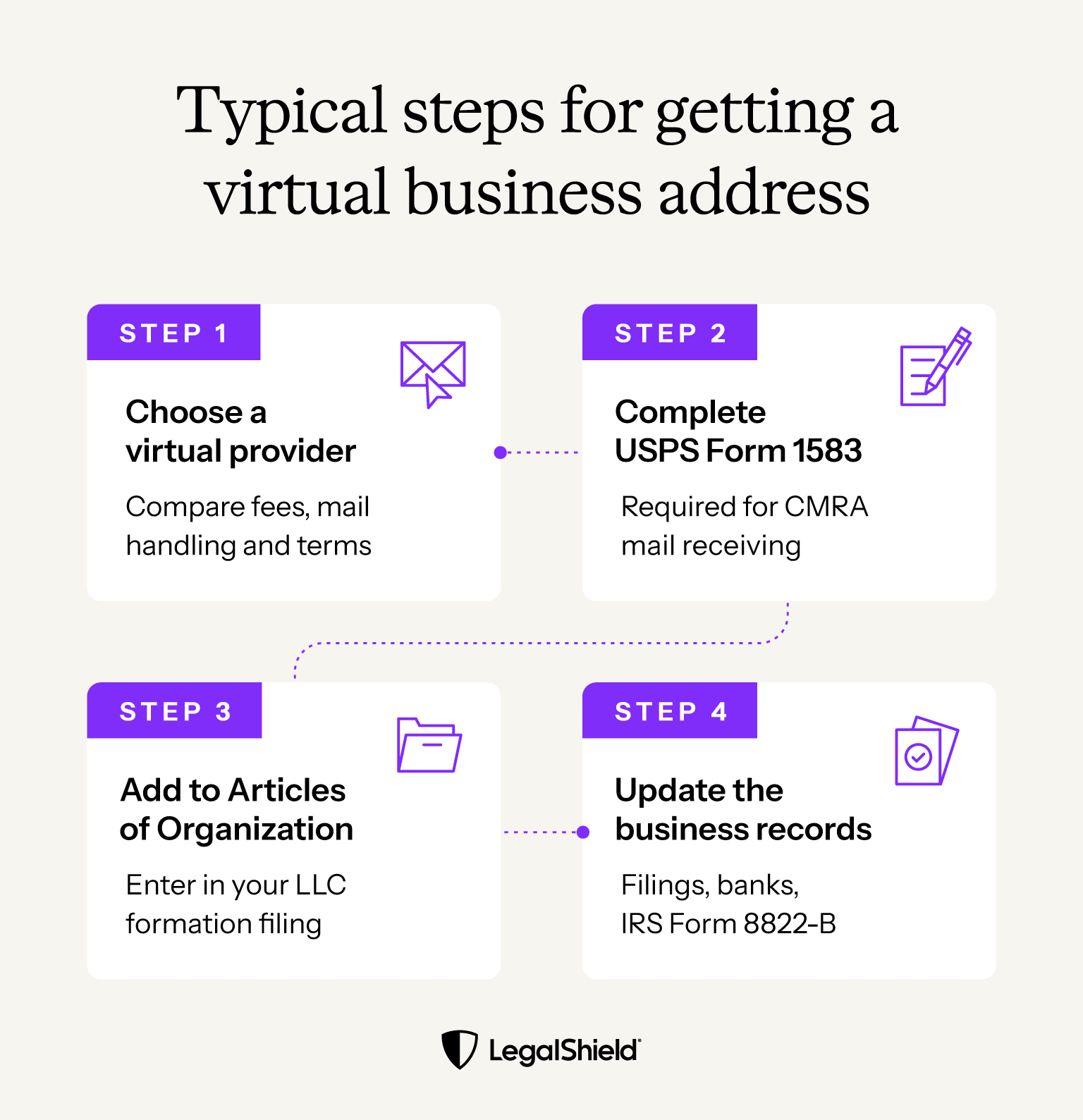
The process of getting and using a virtual address can vary by state. For instance, some states ask for different address fields in formation documents, annual reports, or business licenses. Others distinguish between a principal office address and a mailing address.
Similarly, the process of changing your LLC’s address, such as when you move to a virtual address or away from one, can be state-dependent. You might need to update different business filings, tax accounts, permits, and licenses, depending on where you are.
A virtual address for LLC use can help with privacy and professionalism. But it still has to fit your business operations.
Legal guidance can help you nail this. A LegalShield Membership can connect you with a provider law firm for affordable guidance. You can get answers about using your virtual address in certain records, how to think about your registered agent address, the contract terms to review before choosing a provider, and more.
Get answers as you build and manage your LLC with a LegalShield Small Business Plan.
LegalShield® is a trademark of Pre-Paid Legal Services, Inc. (“LegalShield”). LegalShield provides access to legal services offered by a network of provider law firms to LegalShield members through membership-based participation. Neither LegalShield nor its officers, employees or sales associates directly or indirectly provide legal services, representation, or advice. Small Business Legal Plans and certain benefits are not available in all states. See a Small Business Legal Plan contract for a specific state for complete terms, coverage, amounts, and conditions. The information made available in this blog is meant to provide general information and is not intended to provide legal advice, render an opinion, or provide a recommendation as to a specific matter. The blog post is not a substitute for competent legal counsel from a licensed professional lawyer in the state or province where your legal issues exist, and you should seek legal counsel for your specific legal matter. Information contained in the blog may be provided by authors who could be a third-party paid contributor. All information by authors is accepted in good faith, however, LegalShield makes no representation or warranty of any kind, express or implied, regarding the accuracy, adequacy, validity, reliability, availability, or completeness of such information.

Yes, you can usually start an LLC with a home address. But that can make your home address more visible on business records, customer materials, and vendor documents. A virtual business address can offer more privacy.
The requirements can depend on the state, the address provider, and the purpose of the address, but it is sometimes possible for a non-U.S. resident to use a virtual address for their LLC. To confirm, check with your state and the provider, and consider legal guidance.
No, you don’t need a virtual address to start an LLC. It’s just something that can provide some benefits. You need an address that meets state requirements for business filings and records, but it certainly doesn’t have to be a virtual address.
This comes down to the policies of both the bank and the virtual address provider. Many banks will require a physical business address and proof of identity, plus tax info. Virtual address providers sometimes specify that customers can or cannot use their addresses for banking. It’s helpful to check directly with banks and providers.
Content Specialist at LegalShield, creating educational resources about legal and consumer protection topics. She focuses on making complex legal and financial concepts accessible to readers and has contributed to various educational articles on consumer rights and protections.
By the end of this blog, you’ll get a high-level summary of trademarking a name and logo, how logos differ from business names and artwork, and how much it all costs.

A DBA is a name registration that lets you run your business under a name other than your personal legal name or legal business entity. While a DBA offers branding flexibility and market expansion opportunities without creating a new legal structure, it does not provide legal liability protection, tax benefits, or function as a business license.

An indemnity agreement settles the “who is responsible” question ahead of time. One party promises, in writing, to cover certain losses tied to the work, so the other isn't left with the bill. These promises appear in construction contracts, leases, and business sales.

A certificate of good standing is official proof from your state that your business is registered and current on its requirements. Most lenders and agencies want a recent one, so it helps to know how to get it before someone asks.

Whether the goal is selling a company, bringing in a business partner, or passing it to a family member, the LLC ownership transfer often involves reviewing the LLC's operating agreement and the applicable state's rules.

If you want to do business under a name that isn't your own legal name or your LLC's registered name, you need a trade name, also known as a doing business as (DBA) name.

A consulting agreement is a contract between a service provider, such as an independent contractor, and a recipient.

Hold harmless agreements can help reduce a business's liability by having signatories accept a certain amount of risk.